大問1 解答・解説
大問1(1)の解説をクリックして見る
【解説】
マイナスの数を引くとプラスになります。
$$ \begin{align*} -5-(-8) &= -5+8 \\ &= 3 \end{align*} $$
答: $3$
大問1(2)の解説をクリックして見る
【解説】
掛け算・割り算は、足し算・引き算より先に計算します。
$$ \begin{align*} (-48) \div 8 - 3 &= - 6 - 3 \\ &= -9 \end{align*} $$
答: $9$
大問1(3)の解説をクリックして見る
【解説】
展開して文字ごとにまとめます。
$$ \begin{align*} 3(2a + b) - (3a - 4b) &= 6a + 3b - 3a + 4b \\ &= 3a + 7b \end{align*} $$
答: $3a + 7b$
大問1(4)の解説をクリックして見る
【解説】
ひとつの項なのでまとめて計算することができます。
$$ \begin{align*} \frac{3}{2} ab^2 \div (- \frac{5}{6} b^2) &= - \frac{3ab^2 \times 6}{2 \times 5b^2} \\ &= - \frac{3a \cancel{b^2} \times \cancel{6}^{\Large 3}}{\cancel{2} \times 5 \cancel{b^2}} \\ &= - \frac{9}{5} a \end{align*} $$
答: $- \dfrac{9}{5} a$
大問1(5)の解説をクリックして見る
【解説】
$$ \begin{align*} (\sqrt{3} - \sqrt{7})^2 &= \sqrt{3}^2 - 2 \cdot \sqrt{3} \cdot \sqrt{7} + \sqrt{7}^2 \\ &= 3 - 2 \sqrt{21} + 7 \\ &= 10 - 2 \sqrt{21} \end{align*} $$
答: $10 - 2 \sqrt{21}$
大問1(6)の解説をクリックして見る
【解説】
因数分解できないので解の公式を使います。
$ax^2+bx+c=0$の解の公式$x = \dfrac{-b \pm \sqrt{b^2 - 4ac}}{2a}$に当てはめ、
$$ \begin{align*} x &= \frac{-4 \pm \sqrt{4^2 - 4 \times 3 \times (-1)}}{2 \times 3} \\ &= \frac{-4 \pm \sqrt{16 + 12}}{6} \\ &= \frac{-4 \pm \sqrt{28}}{6} \\ &= \frac{-4 \pm 2 \sqrt{7}}{6} \\ &= \frac{-2 \pm \sqrt{7}}{3} \end{align*} $$
答: $x = \dfrac{-2 \pm \sqrt{7}}{3}$
大問1(7)の解説をクリックして見る
【解説】
比例なので$y = ax$の式になります。
傾きは、$x=1$のときの$y$の値から求めるのがわかりやすいです。
$$y = - \dfrac{5}{6} x$$
他の$(x, y)$についても式が成り立つ事がわかります。
答: $y = - \dfrac{5}{6} x$
大問1(8)の解説をクリックして見る
【解説】
与式は比例定数が正の反比例の式です。
なので$y$の最小値は$x=3$のとき、最大値は$x = \dfrac{1}{2}$のときである事がわかります。
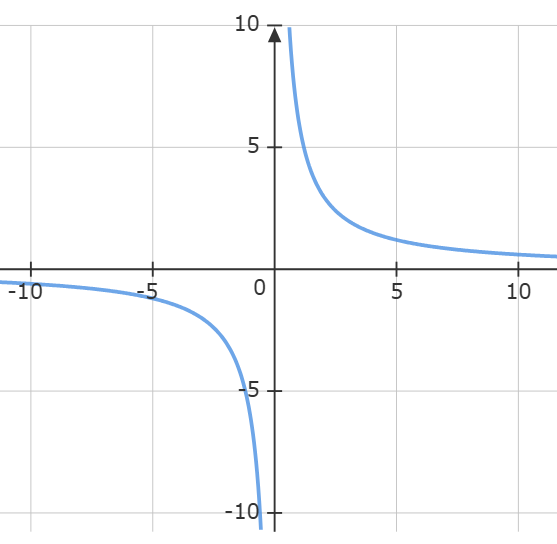
$x=3$のとき、$y = \dfrac{6}{3} = 2$
$x = \dfrac{1}{2}$のとき、$y = 6 \div \dfrac{1}{2} = 6 \times 2 = 12$
よって$y$の変域は$2 \leqq x \leqq 12$
答: $2 \leqq x \leqq 12$
大問1(9)の解説をクリックして見る
【解説】
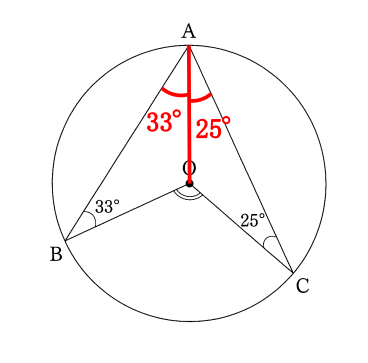
$\mathrm{OA}, \; \mathrm{OB}, \; \mathrm{OC}$は円$\mathrm{O}$の半径で同じ長さなので、$ \triangle \mathrm{OAB}$と$\triangle \mathrm{OAC}$は二等辺三角形である事がわかります。
よって$\angle \mathrm{OAB} = 33^{\circ}, \; \angle \mathrm{OAC} = 25^{\circ}$となり、$ \angle \mathrm{BAC} = 58^{\circ}$となります。
$\angle \mathrm{BAC}$は弧$\mathrm{BC}$に対する円周角なので、弧$\mathrm{BC}$に対する中心角である$ \angle \mathrm{BOC}$の$\dfrac{1}{2}$の大きさです。
よって$\angle \mathrm{BOC} = \angle \mathrm{BAC} \times 2 = 58^{\circ} \times 2 = 116^{\circ}$
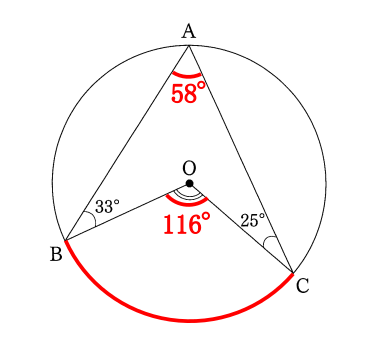
答: $116(^{\circ} \;)$
【別解】
円周角と中心角に気付かなくても、三角形を利用して解くことができます。
$\angle \mathrm{OBA} = \angle \mathrm{OAB} = 33^{\circ}$より、$\angle \mathrm{AOB} = 180 - 33 \times 2 = 114^{\circ}$
$\angle \mathrm{OCA} = \angle \mathrm{OAC} = 25^{\circ}$より、$\angle \mathrm{AOC} = 180 - 25 \times 2 = 130^{\circ}$
よって$\angle \mathrm{BOC} = 360 - \angle \mathrm{AOB} - \angle \mathrm{AOC} = 360 - 114 - 130 = 1116^{\circ}$
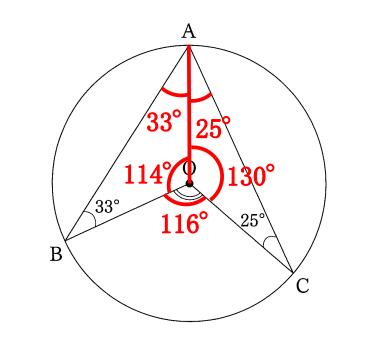
答: $116(^{\circ} \;)$
大問1(10)の解説をクリックして見る
【解説】
$\mathrm{A}$があたりの場合、はずれの場合などの場合分けをなるべく避けて計算したいところです。
確率で、少なくとも〇〇の確率を求めるときは、その反対の確率を出して全体の確率から引くという事がよく行われます。
本問では、二人ともはずれの確率を求め、全体の確率から引いて答えを導きます。
$\mathrm{A}$がはずれの確率は$\dfrac{3}{5}$、$\mathrm{A}$がはずれを引いた後、$\mathrm{B}$がはずれを引く確率は$\dfrac{2}{4}$です。
よって二人ともはずれの確率は$\dfrac{3}{5} \times \dfrac{2}{4} = \dfrac{3}{10}$、
少なくとも一人があたりを引く確率は$1 - \dfrac{3}{10} = \dfrac{7}{10}$となります。
答: $\dfrac{7}{10}$
大問1(11)の解説をクリックして見る
【解説】
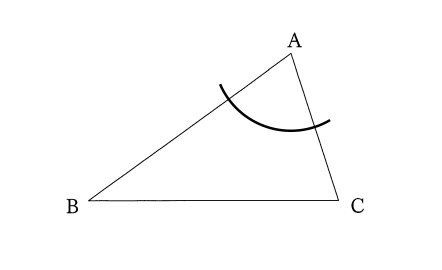
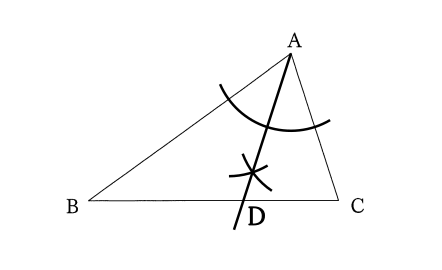
$\angle \mathrm{A}$の二等分線を作図します。
まずコンパスで$\mathrm{A}$を中心にして$\mathrm{AB}$、$\mathrm{AC}$と交わる弧を描きます。
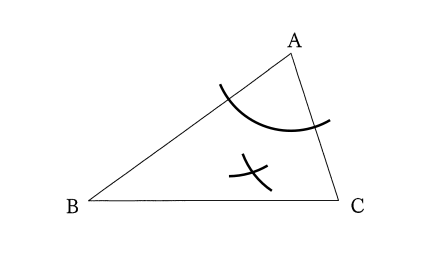
弧と$\mathrm{AB}$、$\mathrm{AC}$の交点から、同じ半径で弧を描きます。
弧と弧の交点と点$\mathrm{A}$を通る直線を引くと、その直線と$\mathrm{BC}$の交点が$\mathrm{D}$になります。
答: